
Luxor: Capital of Immortality
Perched majestically along the banks of the Nile, Luxor stands as the undisputed crown jewel of global cultural tourism. Far more than a conventional travel destination, the city is an expansive open-air museum preserving nearly a third of the world’s ancient monuments. Known in antiquity as Thebes (Waset), it served as the glorious capital of the New Kingdom and the religious heart of the Pharaonic Empire at its zenith. The city reflects ancient Egyptian cosmology: the East Bank represents dawn, vitality, and the living, while the West Bank embodies dusk, eternity, and the passage into the afterlife.
The East Bank: The Realm of the Living and Divine Sanctuaries
The East Bank was the epicenter of civic life and supreme religious ceremonies, dominated by two colossal temple complexes aligned with the movement of the sun.
1. Karnak Temple Complex: A Monumental Epic of Sacred Architecture
Karnak is the largest religious complex ever conceived in human history. Developed across more than two millennia by approximately thirty successive pharaohs, it served as the cult center for the Theban Triad: Amun-Ra, Mut, and Khonsu.
-
The Avenue of Sphinxes (Dromos): The ceremonial entrance welcomes visitors with ram-headed sphinxes protecting figures of the pharaoh, symbolizing Amun's divine guardianship.
-
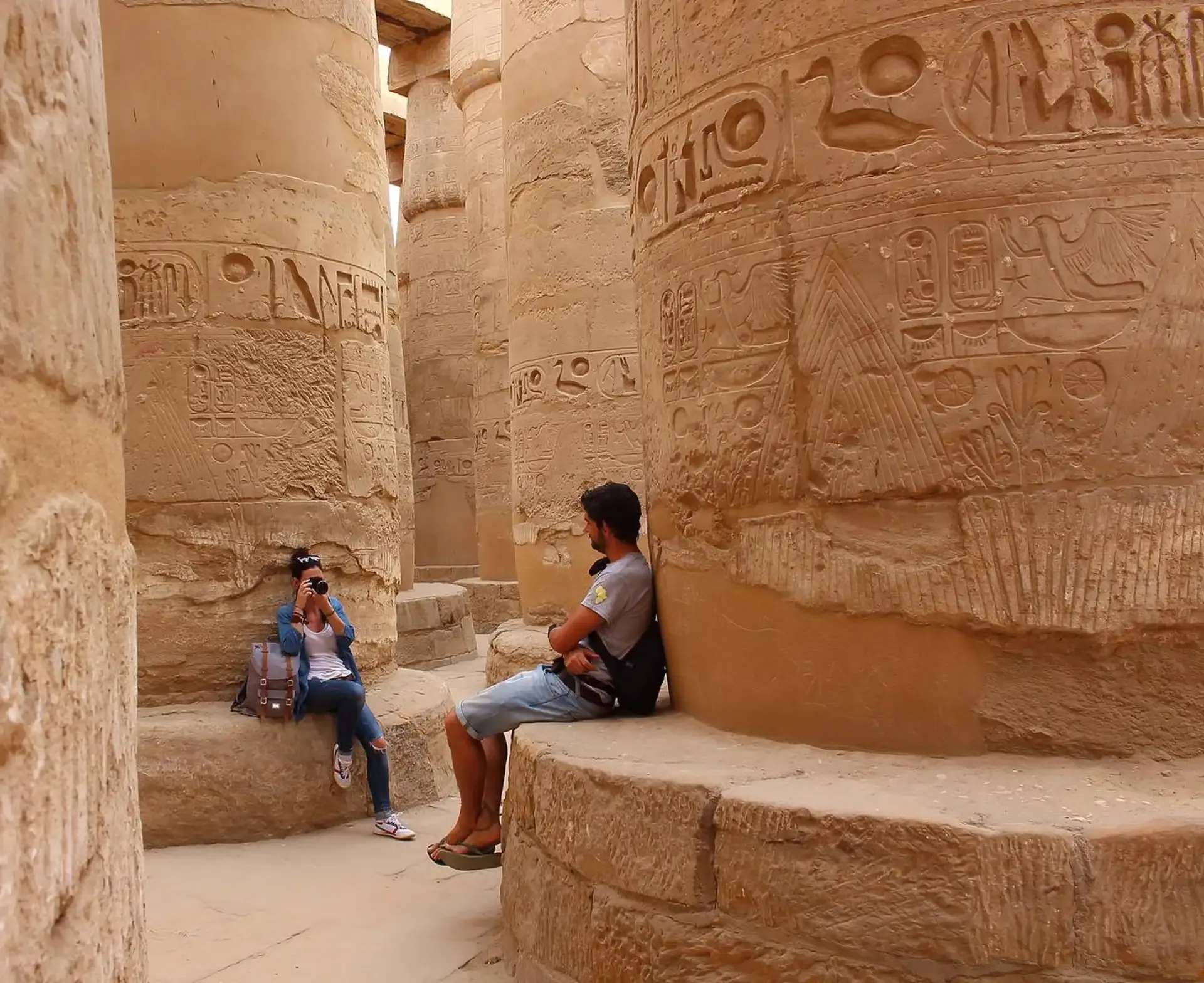
The Great Hypostyle Hall: Spanning over 5,000 square meters, this architectural marvel contains 134 towering sandstone columns arranged in 16 rows. Reaching heights of up to 21 meters with open-papyrus capitals, it creates the sensation of walking through an ancient stone forest.
-
The Sacred Lake and Royal Obelisks: Adjacent to the central sanctuary lies the Sacred Lake, where high priests performed daily purification rituals. Towering above the complex is the magnificent pink granite obelisk of Queen Hatshepsut, quarried from a single stone block in Aswan.
2. Luxor Temple: The Sanctuary of Royal Renewal
Located roughly three kilometers south of Karnak along the riverbank, Luxor Temple was initiated by Amenhotep III and later expanded by Ramesses II. Unlike Karnak, it was primarily dedicated not to gods directly, but to the rejuvenation of kingship.
-
The Opet Festival: The temple served as the focal destination for the annual Opet Festival, during which the divine statues of Amun, Mut, and Khonsu were carried in sacred barques down the 2.7-kilometer Avenue of Sphinxes from Karnak to Luxor.
-
The Colossal Pylon and the Lone Obelisk: The grand facade features colossal seated statues of Ramesses II and an intricately carved granite obelisk (whose counterpart now stands at the Place de la Concorde in Paris).
-
Layers of Civilizations: Inside the court, architectural layers reveal centuries of history, including a Roman sanctuary, Christian frescoes, and the 13th-century Mosque of Abu Haggag built directly atop the pharaonic ruins.
The West Bank: The Necropolis and the Journey to the Afterlife
Crossing the Nile to the West Bank reveals the stark, dramatic cliffs of the Theban Hills, where ancient Egyptians carved their eternal resting places away from tomb raiders, beneath a natural pyramid-shaped mountain peak known as Al-Qurn.
1. The Valley of the Kings
Hidden in a sun-baked limestone canyon, this royal necropolis served as the burial ground for pharaohs of the 18th, 19th, and 20th Dynasties.
-
Underground Masterpieces: Over 60 rock-cut tombs penetrate deep into the mountain, covered in vivid, well-preserved frescoes illustrating sacred funerary texts such as the Book of the Dead and the Amduat.
-
KV62 – The Tomb of Tutankhamun: Discovered by Howard Carter in 1922 with its treasures intact, it remains a defining archaeological milestone.
-
Tombs of Seti I and Ramesses VI: Renowned for their astronomical ceilings, deep corridors, and brilliant pigments that retain their intensity thousands of years later.
2. The Mortuary Temple of Hatshepsut (Deir el-Bahari)
Carved into the sheer limestone cliffs, this terraced mortuary temple is one of the most striking architectural compositions from the ancient world, designed by the royal architect Senenmut.
-
Terraced Colonnades: Three ascending tiers connected by grand ramps mirror the natural strata of the surrounding cliffs.
-
Historic Reliefs: Wall carvings illustrate Hatshepsut's divine birth, her coronation, and the expedition to the land of Punt, transporting exotic incense trees, gold, and ivory.
3. The Colossi of Memnon and the Valley of the Queens
-
The Colossi of Memnon: Two quartzite monoliths rising 18 meters high once guarded the entrance to the vanished mortuary temple of Amenhotep III, enduring earthquakes and floods for over three millennia.
-
The Valley of the Queens: The final resting place of royal wives and princes, highlighted by the tomb of Queen Nefertari (QV66), celebrated for its exquisite artistry and vibrant wall paintings.
Curating the Perfect Luxor Experience
-
Timing & Light: Explore the West Bank and Karnak early in the morning to avoid midday heat and capture low-angle desert light. Visit Luxor Temple around sunset to witness the transition into dramatic nighttime illumination.
-
Aerial Perspectives: An early-morning hot air balloon flight over the West Bank offers panoramic views of the contrast between the green Nile floodplain and the limestone desert valleys.
-
Felucca Sailing: Sunset sails along the Nile provide an ideal vantage point for taking in both banks of the ancient capital.
Comments
Leave a comment